Tattoo artist working on a client's leg tattoo while a shop staff member chats with them in the studio

How Do Tattoo Deposits Work? Deposit Policy Guide + Template

A tattoo deposit is a partial payment that turns a booking request into a confirmed appointment. The deposit holds the artist's time, covers design work done before the session, and is subtracted from the final price on tattoo day. Most shops make deposits non-refundable but transferable with enough notice, and they put those rules in a written policy the client agrees to before paying.

Key takeaways

  • A tattoo deposit is not an extra fee. It is part of the tattoo price paid early, and it is credited against the final payment at checkout.
  • An appointment should not be confirmed until the deposit is paid. An unpaid hold is still a booking request, not an appointment.
  • A complete tattoo deposit policy answers eight questions: amount, how it is applied, refundability, rescheduling, no-shows, artist cancellations, design changes, and expiration. The free printable template in this article covers all eight.
  • Porter collects the deposit as part of booking: the client reviews the shop's cancellation policy, pays the deposit, and the appointment locks in. Porter reports 68% fewer no-shows and late cancellations for studios using Porter.

How does a tattoo deposit work, step by step?

A tattoo deposit moves through five stages:

  1. Request. The client submits a booking request with the idea, placement, size, and reference images. Nothing is booked yet.
  2. Quote. The artist reviews the request and sets a price (fixed, range, or hourly), a session length, and the deposit amount.
  3. Deposit. The client agrees to the policy and pays. This is the moment the request becomes a confirmed appointment.
  4. Design. The artist draws the piece.
  5. Checkout. After the session, the deposit is subtracted from the final price and the client pays the balance.

Here is an illustrative example. An artist quotes a piece at $500 to $700 and takes a $100 deposit. The session finishes at $600, so the client pays $500 at checkout, plus any tip.

For multi-session pieces, decide whether the deposit applies to the first session or is held until the last one to protect the whole project. Either works if the client knows which before paying.

The part that tends to get overlooked is record-keeping. When the deposit arrives through Venmo or a DM and the final payment runs through a card reader, someone has to match the two by hand at checkout. That manual match is where a $100 credit can get missed or applied twice.
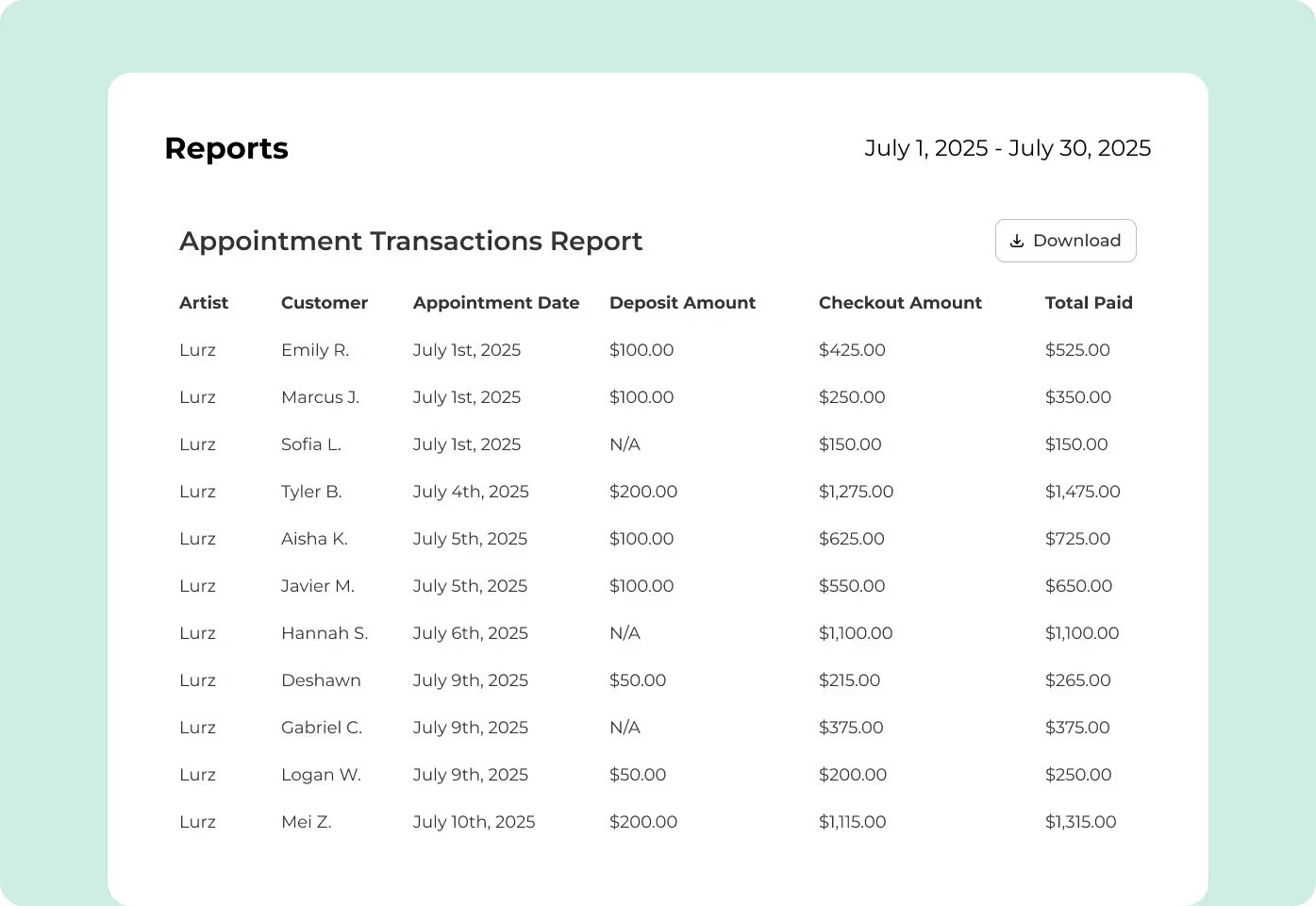
Porter appointment transactions report showing deposit and checkout amounts for each appointment

How much should a tattoo deposit be?

A tattoo deposit should be large enough that losing it matters to the client, and at minimum it should cover the artist's design time. Shops commonly use one of three structures:

  • Flat deposit: one amount for every appointment. It is simple to explain and works well for small and mid-size pieces.
  • Tiered deposit: a set amount by size or session length, such as one amount for sessions under two hours and a larger one for full days.
  • Percentage deposit: a share of the quoted price. It scales automatically, but it requires a quote before the client can pay.

What I would pay attention to is the full-day session. A deposit that works for a palm-size piece barely registers against an eight-hour back session, and that is the appointment that costs the most when the chair sits empty. Porter's tattoo pricing guide covers how to set the price the deposit is based on.

Are tattoo deposits refundable?

Most tattoo deposits are non-refundable, because the money pays for design time and a slot that is hard to resell on short notice. The common middle ground is a deposit that is non-refundable but transferable: it moves to a new date when the client gives enough notice, and it is forfeited for late cancellations and no-shows.

Two exceptions belong in writing. If the artist cancels, the client should be able to choose a new date or a full refund. And deposits should expire after a set period, so a client who keeps postponing does not hold shop credit indefinitely.

Consumer protection and refund rules vary by state and country, so check your local requirements before you finalize your policy. This article is not legal advice.

What should a tattoo deposit policy include?

A tattoo deposit policy should cover the amount, how it applies to the final price, refundability, rescheduling, no-shows and late arrivals, artist cancellations, design changes, and expiration. Timing matters as much as wording: show the policy before the client pays, not after.

If a client disputes a deposit with their card issuer, the evidence Stripe recommends for cancellation disputes includes a copy of your cancellation or refund terms and proof that the customer agreed to them at checkout (Stripe dispute documentation). A policy taped to the front desk is much harder to prove the client saw.

Smiling tattoo client pointing at the Porter app on a phone in a busy tattoo shop

Free tattoo deposit policy template

The template below covers all eight parts, with blanks for your own numbers. Download it, fill it in, and print it for the front desk. Then use the same wording on your booking page and anywhere clients pay, so the version they agree to online matches the one on the wall.

[EDITOR: Insert the P12 Tattoo Deposit Policy Template image here (alt text: Printable tattoo deposit policy template with blanks for deposit amount, rescheduling rules, and client signature), followed by a download button for the PDF. Remove this note before publishing.]

Get started with Porter tattoo scheduling and booking software

How Porter handles tattoo deposits

Porter is tattoo shop management software and a tattoo booking app built for tattoo artists and studios. In Porter, the deposit is part of accepting a booking request, not a separate conversation.

  • Deposit set at acceptance. When an artist accepts a booking request, they choose fixed, range, or hourly pricing, set the session length, and enter the deposit amount on the same screen. If the deposit has not been paid yet, Porter sends the client a link to pay it.
  • Policy shown before payment. Shop managers set a standard cancellation policy in Porter's booking settings, and Porter shows it to clients when they pay the deposit and confirm the appointment. That makes it the natural home for the wording in the template above. Clients pay from their phone with a card, Apple Pay, Affirm, or Afterpay, and paying the deposit locks in the appointment.
  • Follow-up until paid. Porter's automated tattoo deposits send reminders until the deposit is paid, so nobody has to chase it in DMs.
  • Gift cards for deposits. Clients can pay a deposit with a Porter gift card, and the same gift card works at final checkout.
  • Rescheduling rules. Artists can limit how many times and how close to the date a client can reschedule, charge a flat reschedule fee or a new deposit, or turn off client rescheduling.
  • Deposit options when you cancel. When a shop cancels an appointment in Porter's web app, it chooses whether to keep the deposit as credit on the client's account, refund it to the client's card, or forfeit it. Porter never refunds deposits automatically, so the shop can apply clause 6 of the template on its own terms.
  • Commission splits on deposits. For shops using Porter's commission split payout option, Porter automatically splits deposit and appointment payments between the shop and the artist at the time of payment, based on the artist commission splits set for each artist. Tips go 100% to the artist by default.
  • Tipping on the full price. Porter supports tipping on the full tattoo cost, including the deposit already paid, so the tip is not limited to the balance due at checkout.

Porter automatically tracks deposits through checkout. Each appointment's transaction history shows the deposit alongside reschedule fees, tips, and final payments, so the front desk can see what the client has already paid.
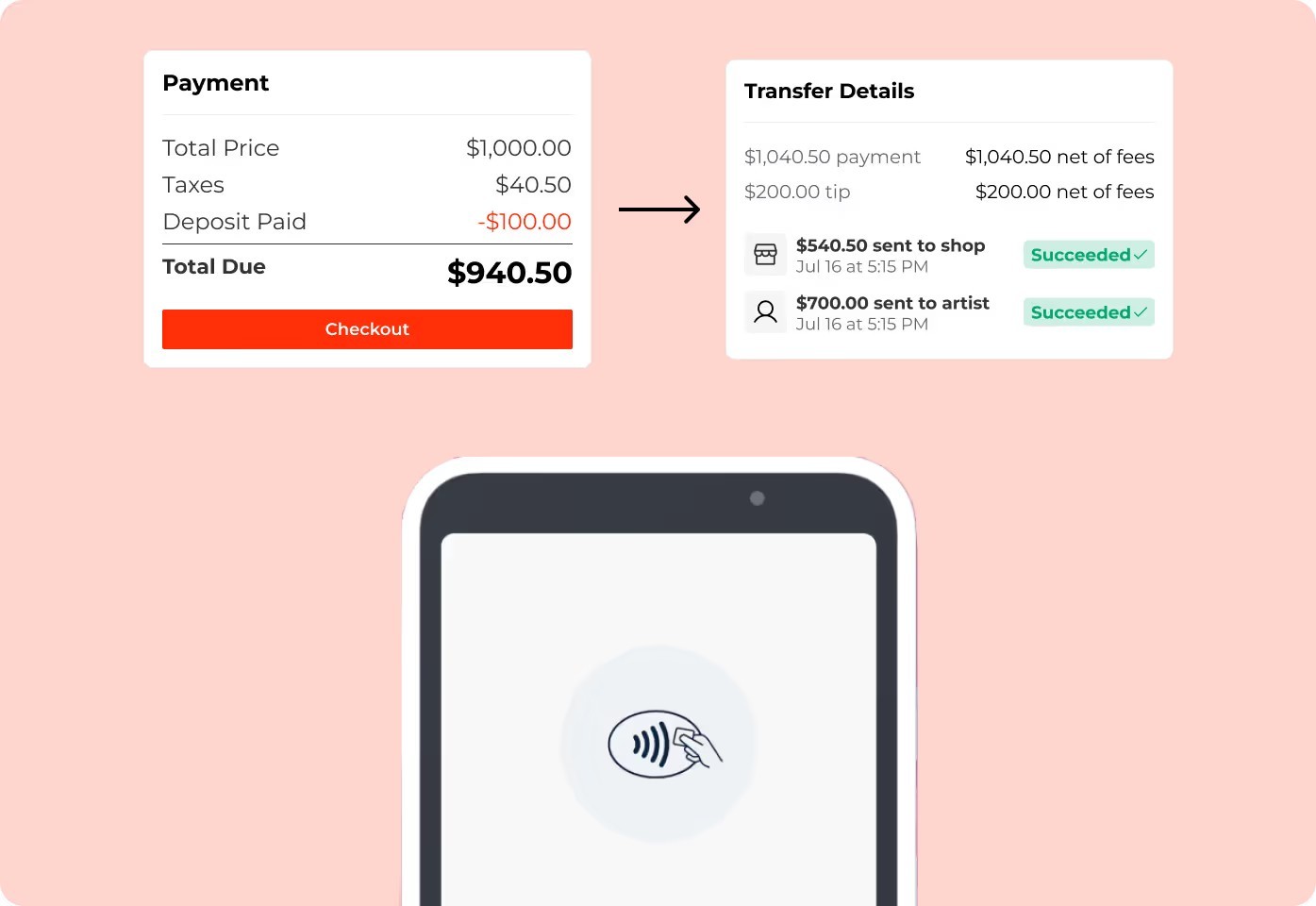
Porter checkout showing a $100 deposit paid and the payment split between the shop and the artist

Porter reports that studios using Porter see 68% fewer no-shows and late cancellations and 15% more appointments. Those are published figures, not guarantees, and deposits work alongside Porter's 48-hour and 1-hour SMS reminders. For the full playbook, read how to reduce tattoo no-shows.

Frequently asked questions

Is a tattoo deposit part of the tattoo price?

Yes. A tattoo deposit is normally part of the total price paid in advance and is subtracted from the final payment at checkout. A shop that treats it as a separate booking fee should say so in its policy.

What happens to a tattoo deposit if the artist cancels?

When a tattoo artist cancels, the standard practice is to let the client move the deposit to a new date or receive a full refund.

Do tattoo artists get commission on deposits?

It depends on the shop's agreement. Some shops split a forfeited deposit the same way they split a completed tattoo, because the artist lost the time. In Porter, shops using the commission split payout option have deposit payments split between the artist and the shop automatically at the time of payment.

Make the deposit part of booking

A deposit policy only protects the chair when the client agrees to it before paying and the deposit follows the appointment through checkout. Print the template, set your numbers, and keep the online and front-desk versions identical. See how Porter collects tattoo deposits automatically.

A tattoo deposit is a partial payment that turns a booking request into a confirmed appointment. The deposit holds the artist's time, covers design work done before the session, and is subtracted from the final price on tattoo day. Most shops make deposits non-refundable but transferable with enough notice, and they put those rules in a written policy the client agrees to before paying.

Key takeaways

  • A tattoo deposit is not an extra fee. It is part of the tattoo price paid early, and it is credited against the final payment at checkout.
  • An appointment should not be confirmed until the deposit is paid. An unpaid hold is still a booking request, not an appointment.
  • A complete tattoo deposit policy answers eight questions: amount, how it is applied, refundability, rescheduling, no-shows, artist cancellations, design changes, and expiration. The free printable template in this article covers all eight.
  • Porter collects the deposit as part of booking: the client reviews the shop's cancellation policy, pays the deposit, and the appointment locks in. Porter reports 68% fewer no-shows and late cancellations for studios using Porter.

How does a tattoo deposit work, step by step?

A tattoo deposit moves through five stages:

  1. Request. The client submits a booking request with the idea, placement, size, and reference images. Nothing is booked yet.
  2. Quote. The artist reviews the request and sets a price (fixed, range, or hourly), a session length, and the deposit amount.
  3. Deposit. The client agrees to the policy and pays. This is the moment the request becomes a confirmed appointment.
  4. Design. The artist draws the piece.
  5. Checkout. After the session, the deposit is subtracted from the final price and the client pays the balance.

Here is an illustrative example. An artist quotes a piece at $500 to $700 and takes a $100 deposit. The session finishes at $600, so the client pays $500 at checkout, plus any tip.

For multi-session pieces, decide whether the deposit applies to the first session or is held until the last one to protect the whole project. Either works if the client knows which before paying.

The part that tends to get overlooked is record-keeping. When the deposit arrives through Venmo or a DM and the final payment runs through a card reader, someone has to match the two by hand at checkout. That manual match is where a $100 credit can get missed or applied twice.

Porter appointment transactions report showing deposit and checkout amounts for each appointment

How much should a tattoo deposit be?

A tattoo deposit should be large enough that losing it matters to the client, and at minimum it should cover the artist's design time. Shops commonly use one of three structures:

  • Flat deposit: one amount for every appointment. It is simple to explain and works well for small and mid-size pieces.
  • Tiered deposit: a set amount by size or session length, such as one amount for sessions under two hours and a larger one for full days.
  • Percentage deposit: a share of the quoted price. It scales automatically, but it requires a quote before the client can pay.

What I would pay attention to is the full-day session. A deposit that works for a palm-size piece barely registers against an eight-hour back session, and that is the appointment that costs the most when the chair sits empty. Porter's tattoo pricing guide covers how to set the price the deposit is based on.

Are tattoo deposits refundable?

Most tattoo deposits are non-refundable, because the money pays for design time and a slot that is hard to resell on short notice. The common middle ground is a deposit that is non-refundable but transferable: it moves to a new date when the client gives enough notice, and it is forfeited for late cancellations and no-shows.

Two exceptions belong in writing. If the artist cancels, the client should be able to choose a new date or a full refund. And deposits should expire after a set period, so a client who keeps postponing does not hold shop credit indefinitely.

Consumer protection and refund rules vary by state and country, so check your local requirements before you finalize your policy. This article is not legal advice.

What should a tattoo deposit policy include?

A tattoo deposit policy should cover the amount, how it applies to the final price, refundability, rescheduling, no-shows and late arrivals, artist cancellations, design changes, and expiration. Timing matters as much as wording: show the policy before the client pays, not after.

If a client disputes a deposit with their card issuer, the evidence Stripe recommends for cancellation disputes includes a copy of your cancellation or refund terms and proof that the customer agreed to them at checkout (Stripe dispute documentation). A policy taped to the front desk is much harder to prove the client saw.

Smiling tattoo client pointing at the Porter app on a phone in a busy tattoo shop

Free tattoo deposit policy template

The template below covers all eight parts, with blanks for your own numbers. Download it, fill it in, and print it for the front desk. Then use the same wording on your booking page and anywhere clients pay, so the version they agree to online matches the one on the wall.

[EDITOR: Insert the P12 Tattoo Deposit Policy Template image here (alt text: Printable tattoo deposit policy template with blanks for deposit amount, rescheduling rules, and client signature), followed by a download button for the PDF. Remove this note before publishing.]

Get started with Porter tattoo scheduling and booking software

How Porter handles tattoo deposits

Porter is tattoo shop management software and a tattoo booking app built for tattoo artists and studios. In Porter, the deposit is part of accepting a booking request, not a separate conversation.

  • Deposit set at acceptance. When an artist accepts a booking request, they choose fixed, range, or hourly pricing, set the session length, and enter the deposit amount on the same screen. If the deposit has not been paid yet, Porter sends the client a link to pay it.
  • Policy shown before payment. Shop managers set a standard cancellation policy in Porter's booking settings, and Porter shows it to clients when they pay the deposit and confirm the appointment. That makes it the natural home for the wording in the template above. Clients pay from their phone with a card, Apple Pay, Affirm, or Afterpay, and paying the deposit locks in the appointment.
  • Follow-up until paid. Porter's automated tattoo deposits send reminders until the deposit is paid, so nobody has to chase it in DMs.
  • Gift cards for deposits. Clients can pay a deposit with a Porter gift card, and the same gift card works at final checkout.
  • Rescheduling rules. Artists can limit how many times and how close to the date a client can reschedule, charge a flat reschedule fee or a new deposit, or turn off client rescheduling.
  • Deposit options when you cancel. When a shop cancels an appointment in Porter's web app, it chooses whether to keep the deposit as credit on the client's account, refund it to the client's card, or forfeit it. Porter never refunds deposits automatically, so the shop can apply clause 6 of the template on its own terms.
  • Commission splits on deposits. For shops using Porter's commission split payout option, Porter automatically splits deposit and appointment payments between the shop and the artist at the time of payment, based on the artist commission splits set for each artist. Tips go 100% to the artist by default.
  • Tipping on the full price. Porter supports tipping on the full tattoo cost, including the deposit already paid, so the tip is not limited to the balance due at checkout.

Porter automatically tracks deposits through checkout. Each appointment's transaction history shows the deposit alongside reschedule fees, tips, and final payments, so the front desk can see what the client has already paid.

Porter checkout showing a $100 deposit paid and the payment split between the shop and the artist

Porter reports that studios using Porter see 68% fewer no-shows and late cancellations and 15% more appointments. Those are published figures, not guarantees, and deposits work alongside Porter's 48-hour and 1-hour SMS reminders. For the full playbook, read how to reduce tattoo no-shows.

Frequently asked questions

Is a tattoo deposit part of the tattoo price?

Yes. A tattoo deposit is normally part of the total price paid in advance and is subtracted from the final payment at checkout. A shop that treats it as a separate booking fee should say so in its policy.

What happens to a tattoo deposit if the artist cancels?

When a tattoo artist cancels, the standard practice is to let the client move the deposit to a new date or receive a full refund.

Do tattoo artists get commission on deposits?

It depends on the shop's agreement. Some shops split a forfeited deposit the same way they split a completed tattoo, because the artist lost the time. In Porter, shops using the commission split payout option have deposit payments split between the artist and the shop automatically at the time of payment.

Make the deposit part of booking

A deposit policy only protects the chair when the client agrees to it before paying and the deposit follows the appointment through checkout. Print the template, set your numbers, and keep the online and front-desk versions identical. See how Porter collects tattoo deposits automatically.

Power your studio with software designed specifically for tattoos.

Porter tattoo artists